Tag: SURFnet

  • Pixelflut: A weekend of pinging on SURFnet Infinity

    Pixelflut: A weekend of pinging on SURFnet Infinity

    This blog post is a collaboration between Max Mudde, Edwin Verheul and Joachim Opdenakker.


    Network stress test 

    A new network – and, in particular, a wonderful collaboration with Nikhef to host one of the core sites – naturally calls for a festive opening. Read more about it here: https://www.surf.nl/nieuws/surf-brengt-hart-van-netwerk-terug-in-eigen-cooperatie

    But as a techie, you naturally want the technology to speak for itself. In collaboration with Nikhef and Studenten Net Twente, we came up with the idea of routing ‘difficult’ traffic through the SURFnet Infinity network. This allowed us to display some impressive graphs during the ceremony, and afterwards, ‘just for fun’, to open this up to the public as a fun internet event.

    But what exactly constitutes ‘heavy’ traffic? Gigabits? Terabits? Although we usually measure network capacity in bits per second, a router does not operate using bits. A router works with packets. Every packet, large or small, takes roughly the same amount of work: the router has to receive it, look up the destination, check whether the packet is allowed through, update counters and then forward the packet via the correct port. Whether that packet is 64 bytes or 1,500 bytes makes hardly any difference.

    Normal internet traffic is a mix of large and small packets. To account for this, we generally use the concept of IMIX, or Internet Mix. This is a standard distribution of the traffic observed in practice on networks. If you take the average of this, you arrive at an average packet size of 350 to 400 bytes. A connection with a capacity of 400 gigabits per second, carrying IMIX traffic, means that the router has to process around 140 million packets per second. 

    But IMIX isn’t enough, of course; we want to show what the network is capable of. Enter: the pixelflut!

    What is a ‘pixel flut’? 

    Imagine a huge digital painting that anyone on the internet can draw on at the same time. There’s no brush or mouse. You draw by sending messages via the internet. Each message colours a single pixel on the screen. You can follow the result live via a livestream. That’s a ‘pixelflut’. The idea comes from the hacker scene and is a regular feature at hacker events. 

    The screen is shared, so anyone can overwrite someone else’s work. If you want your drawing to stay on the screen, you have to keep resending your pixels – and do so faster than all the other ‘pingers’. This creates a fun, chaotic competition. Participants write clever programmes that send as many messages per second as possible. This makes a ‘pixelflut’ an excellent stress test for a network too. 

    What is a ping? 

    A ping packet is just about the smallest packet there is. In this SNT Ping Test, all the information is contained in the destination address, so the contents of the packet can remain empty. To fill that same 400 Gigabit per second connection with such ping packets, the router will have to process around 600 million packets per second. For the same volume of traffic, the router therefore has 4.28 times as much work to do as with IMIX traffic.

    On a ‘normal’ pixel-based chat service, you send text commands to a server. Last weekend’s edition, SNTPings by Studenten Net Twente, works differently: there, you ‘draw’ using pings. 

    A ping is the simplest message you can send over the internet. It works a bit like shouting “Hello, are you there?” in a dark room. Your computer sends a small packet to an address. If that address exists and the device is reachable, a reply comes back. Network administrators have been using ping for decades to check whether a computer or server is reachable and how fast the connection is. Virtually every computer has a built-in ping command. 

    How does a ping become a coloured pixel? 

    The trick lies in the address you send the ping to, not in the contents of the packet. 

    Every device on the internet has an IP address, which is similar to a postal address. The latest version, IPv6, has extremely long addresses. There are so many of them that there is more than enough space to hide information within the address itself. SNTPings makes clever use of this. An address looks like this: 

    2001:610:5ea:221e:<X>:<Y>:<B><G>:<R><A> 

    The numbers are written in hexadecimal, a number system commonly used by computers (using 0–9 and a–f). For example: with 

    ping6 2001:610:5ea:221e:0019:0019:00d1:ffff 

    Colour the pixel at position (25, 25) a bright yellow, in SNT’s corporate colour. 

    With SNTPings, the receiver does not send a reply. It simply reads the address to which the ping was sent, extracts the position and colour from it, and colours the corresponding pixel on the canvas. One ping therefore equals one pixel. The screen is 4K (3840 × 2160 pixels, over 8 million pixels in total). This means that millions of pings are needed for a single complete image, and you have to keep repeating this process as long as others are drawing over it. 

    A whole weekend of gaming on SURFnet Infinity 

    SNTPings was organised to mark the launch of SURFnet Infinity. The event was open to everyone from 6.00 pm on Friday 9 October until Sunday 11 October. It was the biggest edition ever. The receiving servers were located at Nikhef in Amsterdam. SURF and Nikhef together provided 10 × 400 Gbit/s of connectivity, and the receiver itself was capable of processing up to 1.6 Tbit/s of pings. By way of comparison, that is thousands of times faster than a high-speed fibre-optic connection at home. 

    A lot was going on behind the scenes: 

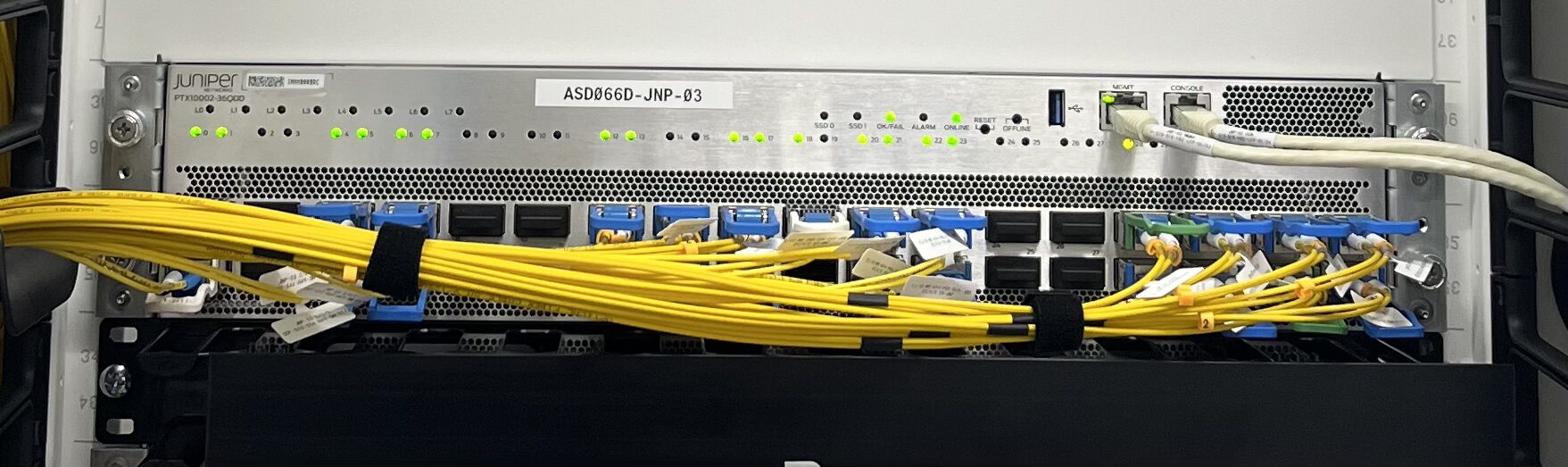
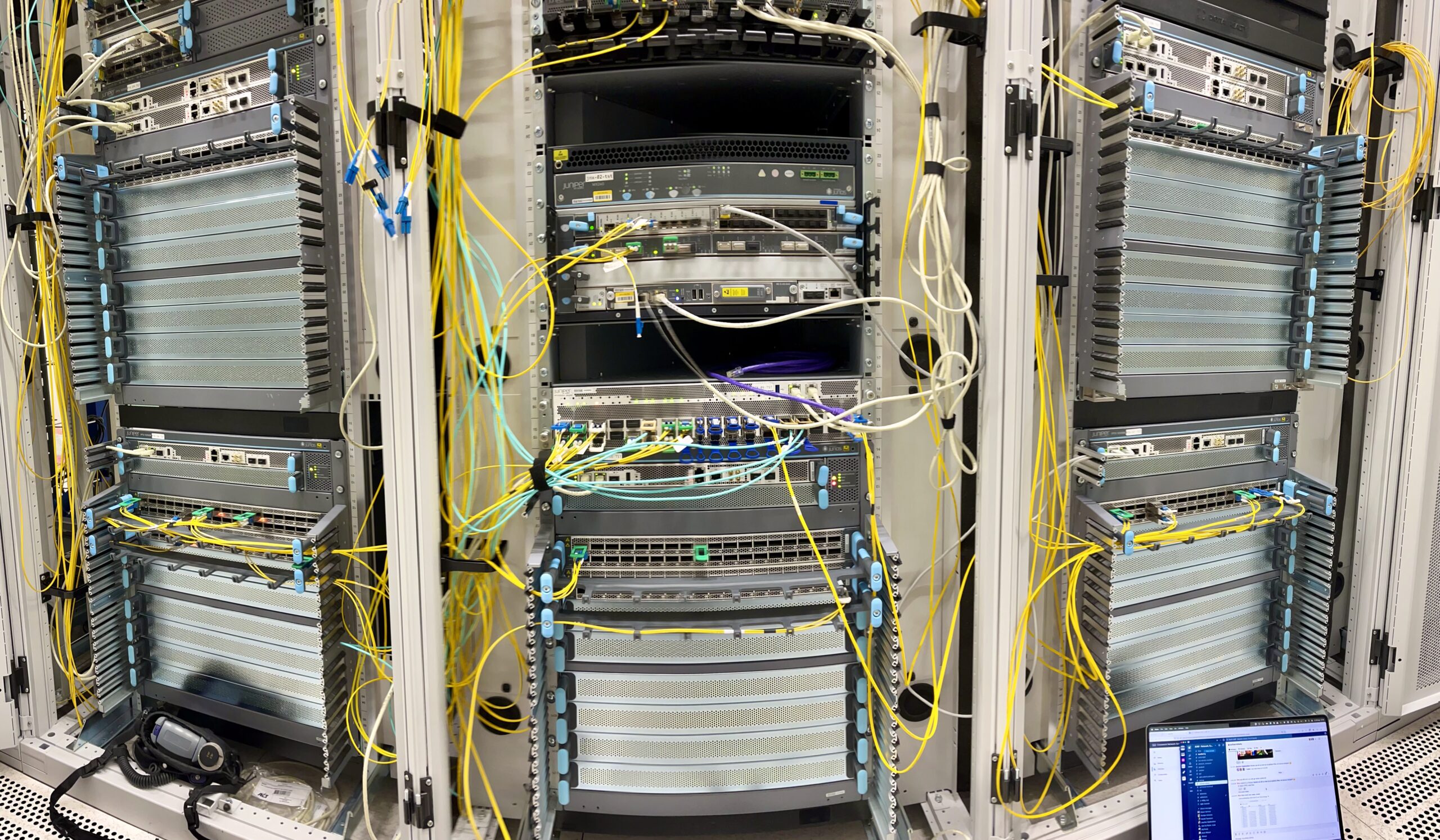
    • SURFnet Infinity router: All traffic first entered via the SURFnet Infinity peering router, an HPE/Juniper PTX10002-36QDD. 
    • Nikhef router: That traffic was forwarded to the Nokia 7750 at Nikhef. 
    • Monitoring: some of the traffic was routed to a monitoring system. This enabled SNT to see who was posting what and, where necessary, to block inappropriate content. 
    • Fair play: anyone with an extremely high ping was artificially assigned a higher packet loss rate. The higher your ping, the greater the proportion of packets that ‘disappeared’ en route. This ensured that even participants with a standard home internet connection had a fair chance. 
    • Drawing: the pings that did get through were sent to the ‘painting server’, which displayed them on the canvas. 
    • Broadcast: a dedicated server streamed the canvas live to the rest of the world. 

    Statistics 

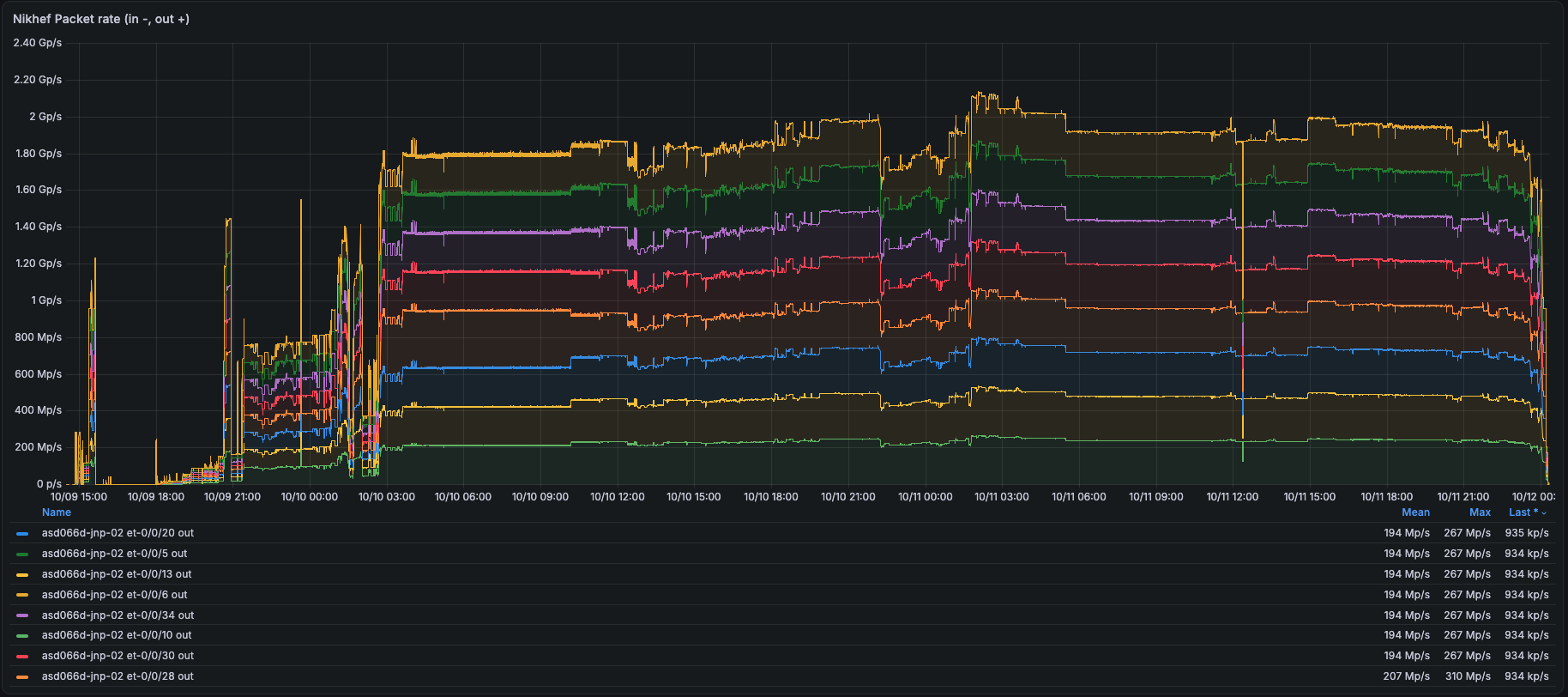
    As you can see from the screenshot below, the maximum parcel throughput peaked in the early hours of Sunday 11 October 2026: no fewer than 2.14 billion parcels per second. This graph shows the 8x400G ports that SURF installed in collaboration with Nikhef.
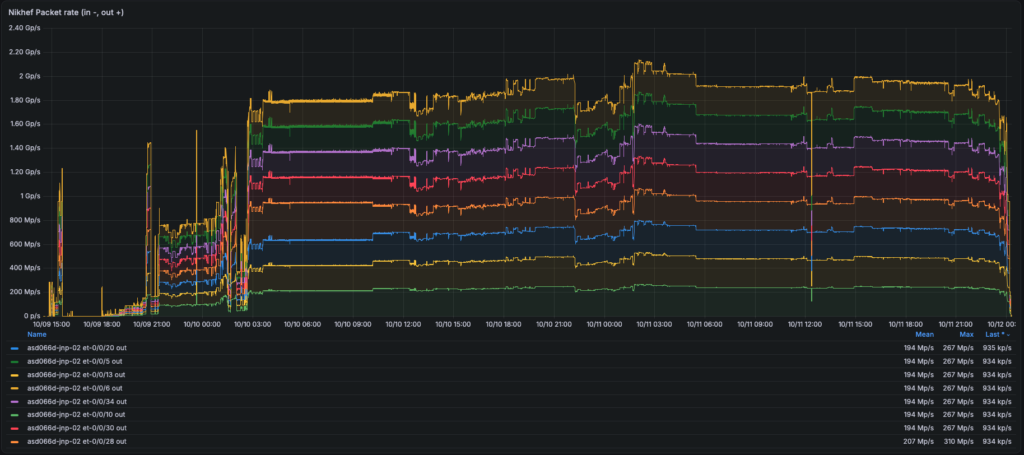
    Packet rate towards Nikhef/SNT canvas servers.

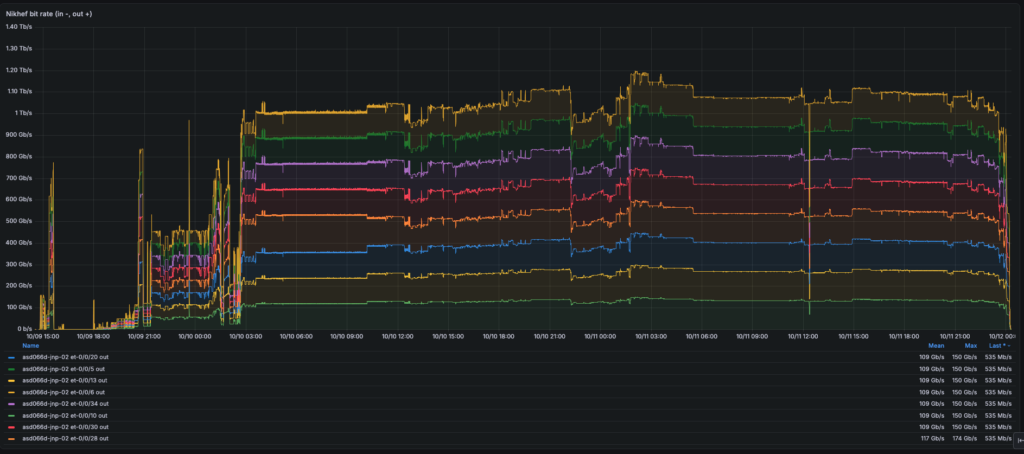
    Below is the resulting bit-rate:

    Bit rate towards Nikhef/SNT canvas servers.

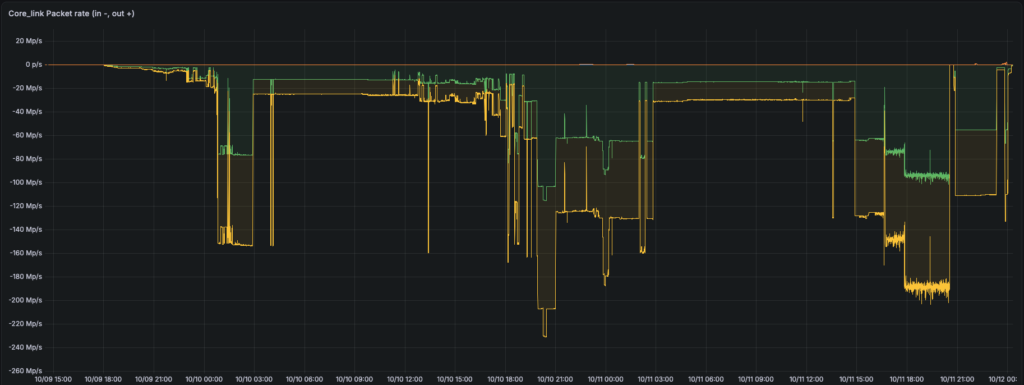
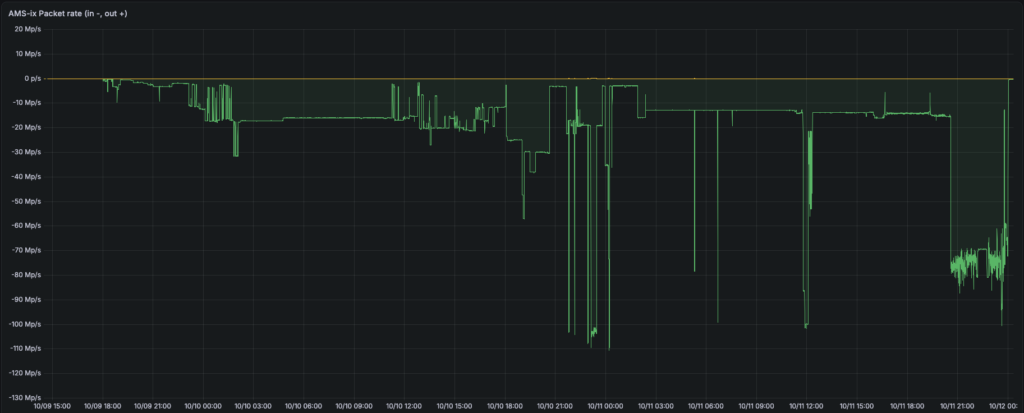
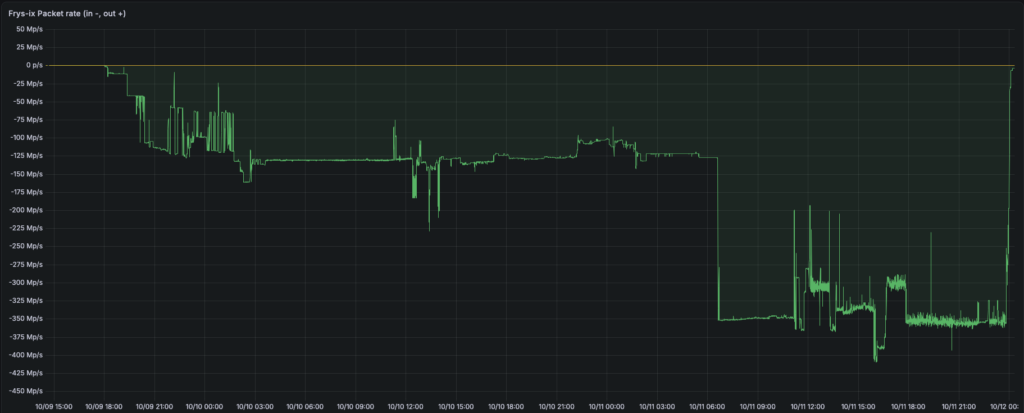
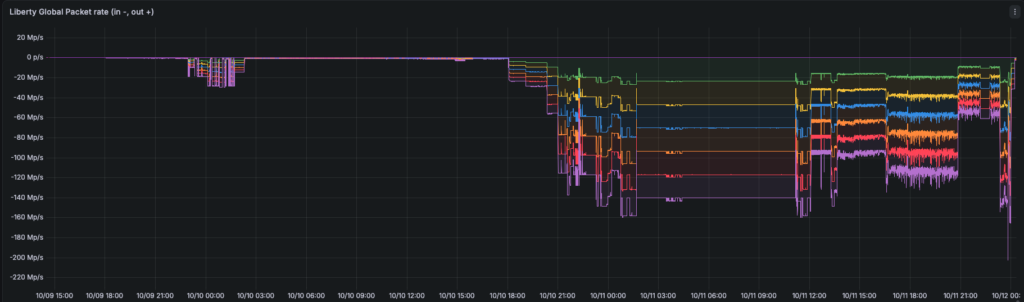
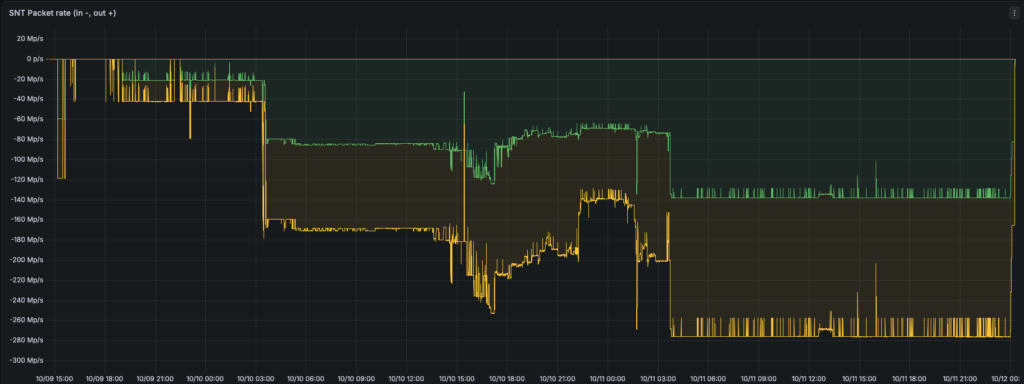
    For incoming traffic, various routes were made available, including a number of internet exchanges, transit providers and, of course, the SURFnet Infinity production network:
    Result

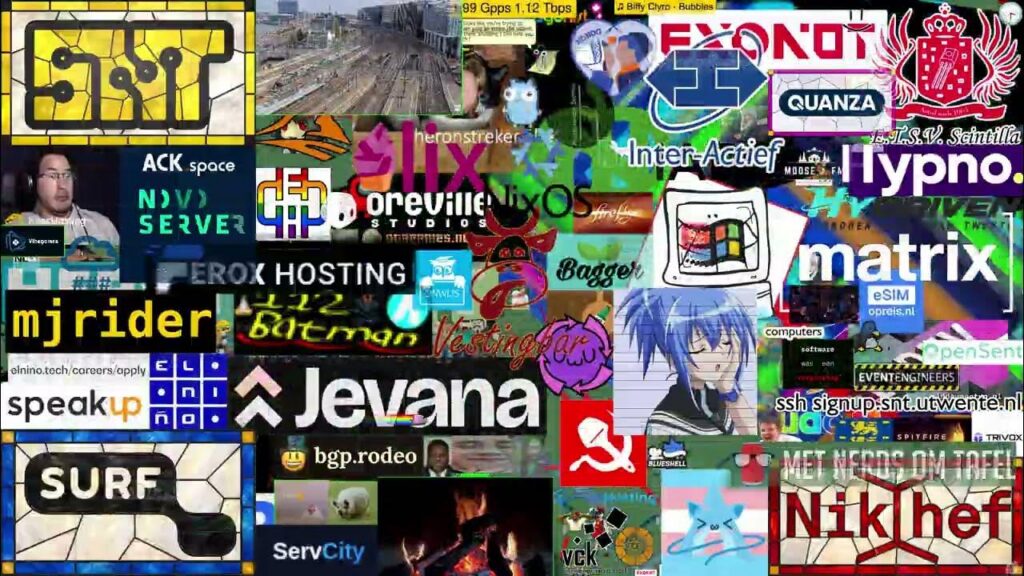
    The result was a weekend full of pixel art, logos and, above all, a great deal of chaos. The best bits can be seen in the time-lapse, which shows the weekend at 200 times normal speed. Meanwhile, the new network proved that it can handle such enormous volumes of traffic without any problems. 
  • Ready for the future with an 800G peering network

    Ready for the future with an 800G peering network

    SURF is building a new generation of the SURF network. This blog is part of a series of blogs about SURFnet Infinity. With SURFnet Infinity, SURF has opted for a vendor-neutral architecture based on open standards, ensuring that the network can continue to develop without restriction. You can read more about the new SURF network here.

    In this blog, we’ll take a closer look at the technology and focus on SURFnet Infinity’s new peering network.

    The first step

    In 2025, SURF organised a mini-competition in collaboration with the broker Nomios. Juniper-HPE emerged as the winner for the core and peering domain with its PTX10000 platform. In addition to the hardware, the anti-DDoS solution used by SURF was also part of this mini-competition. As part of the Juniper-HPE proposal, the new software package from supplier Corero, Corero Smartwall One, was selected. This version has been specifically developed to support Juniper PTX. This new version of the software package offers a clear upgrade path from the existing Corero implementation currently used by SURF.

    Replacement of the peering routers

    In 2025, we quietly carried out a migration of the existing peering routers in the SURFnet8 domain. Until August 2025, all of SURF’s external connections were directly connected to the core routers in Amsterdam. There was a need for greater capacity and increased resilience within the SURF network. As the high-level architecture of the SURFnet Infinity network had already been finalised at that point, we decided to apply the new architecture here for the first time. Dedicated peering routers enable faster capacity expansions, a higher level of resilience in the event of DDoS attacks, and a smaller blast radius. The latter is a key aspect in the separation of network services, as it allows us to significantly limit the impact on other domains.

    In early 2026, we migrated the existing Corero anti-DDoS service to the new package, Smartwall One. This is still linked to the existing Juniper MX-based peering routers, but offers plug-and-play capability for integration with PTX routers.

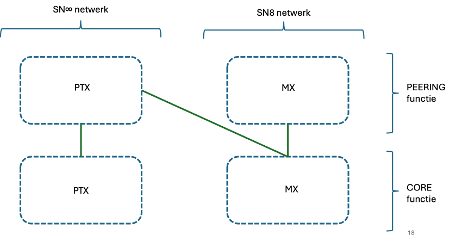
    In July and August 2026, the migration to the new PTX platform took place. New PTX10002-36QDD routers were installed at the main peering locations, Equinix AMS7 and Nikhef. Both routers were provided with direct connections to the new SURFnet Infinity core network, which is currently under construction, as well as direct connections to the SURFnet8 core network. This enables us to gradually migrate customers from SURFnet8 to SURFnet Infinity, with sufficient capacity and without any impact on internet services. By migrating the peering routers ahead of the metro sites and connecting them to both core networks, we can focus fully on migrating the customer sites. There is no need to take routing or capacity into account, as this complex work has already been carried out.

    A diagram is shown below:


    Migration process

    From a bird’s-eye view, such a migration process looks like this:

    • – installation of the new routers
    • – establishing connections with the SN8 core and the SN∞ core
    • – integrate anti-DDoS platform
    • – Migrating the external connections one by one

    This migration was preceded by a major project plan, with the constant aim of causing no impact – or as little as possible – on service delivery. A great deal of planning went into this, particularly at our Nikhef site. Within SURFnet8, one of SURF’s most important peering locations was Digital Realty AMS9. In 2025, SURF decided to relocate the network core to the data centre of one of its members, Nikhef. The Nikhef data centre is one of Amsterdam’s most important connectivity hubs, making it the ideal location for peering. More information about the collaboration: https://www.surf.nl/en/news/surf-moves-network-core-from-private-business-to-member-organisation

    Following consultations with various external parties and peering partners, the necessary cross-connects were requested between Digital Realty AMS9 and Nikhef. This enabled us to connect existing links from parties not physically present at Nikhef to the new peering nodes.

    Field engineers will then migrate all connections from the MX peering router to the PTX peering routers. This means that the optics and fibres will be reconnected on a one-to-one basis. Afterwards, network engineers can use the automation platform developed by SURF to transfer the configuration at the touch of a button. This helps to ensure that the migration proceeds smoothly and without errors.

    Actual migration: a shift in traffic patterns

    The actual migration began in the week of 20 July 2026. We opted for a two-stage approach. At the Asd002a site, the migration was carried out using the ‘big bang’ method. On Monday 20 July at around 10.00, the first gateways were migrated to the new PTX platform. The entire migration was completed that same day at around 13.30. The graph below clearly shows the shift in traffic from SURFnet8 peering (in red) to SURFnet Infinity∞ (in green) at the asd002a site.

    Shift in traffic from SN8 MX peering routers (in red) to SN∞ PTX peering routers (in green) at site ASD002A

    For the peering migration at site Asd001b, we opted for a phased approach. Various external connections needed to be relocated from site Asd001b (Digital Realty AMS9) to Asd066d (Nikhef). Due to the need to re-establish several campus cross-connects and set up new connections, this migration has been spread over several weeks. We are currently still awaiting the final handover and hope to have fully migrated to the PTX platform at Asd066d by the end of October 2026.

    Shift in traffic from SN8 MX peering routers (in red) to SN∞ PTX peering routers (in green) at location ASD001B/ASD066D

    Distribution of traffic between SURFnet 8 and SURFnet∞

    At present, the migration to the SURFnet Infinity metro network is still well into the design and installation phase. For most customers, this means that internet traffic is still routed via the SURFnet 8 core network. For a small number of metro locations, the migrations to SURFnet∞ have already been completed. We can also already see that traffic from the peering nodes is travelling via the SURFnet∞ core network. This is shown below, where traffic from our peering routers to SURFnet Infinity is shown in green and traffic to the SURFnet 8 core network is shown in red.

    Initial traffic to customers on the SN∞ network (shown in green) by peering location.

    Next step: 3rd peering PoP in Frankfurt

    To make the SURF network even more robust, we have decided to also implement geographical redundancy. As part of the expansion of our Cross-Border network, we are also building a new PoP in Frankfurt. This will enable us to establish external connections here as well, as a fully-fledged part of our peering strategy. The aim is to establish connections with other networks at this location later in 2026, thereby increasing our redundancy and capacity.

    Further information

    Would you like to find out more about SURFnet Infinity?

    Follow this project on this page. We also post regular project updates on the network dashboard. Alternatively, please contact us at joachim.opdenakker@surf.nl

  • Researchers! Could the fiber network itself become a new research instrument for your field?

    Researchers! Could the fiber network itself become a new research instrument for your field?


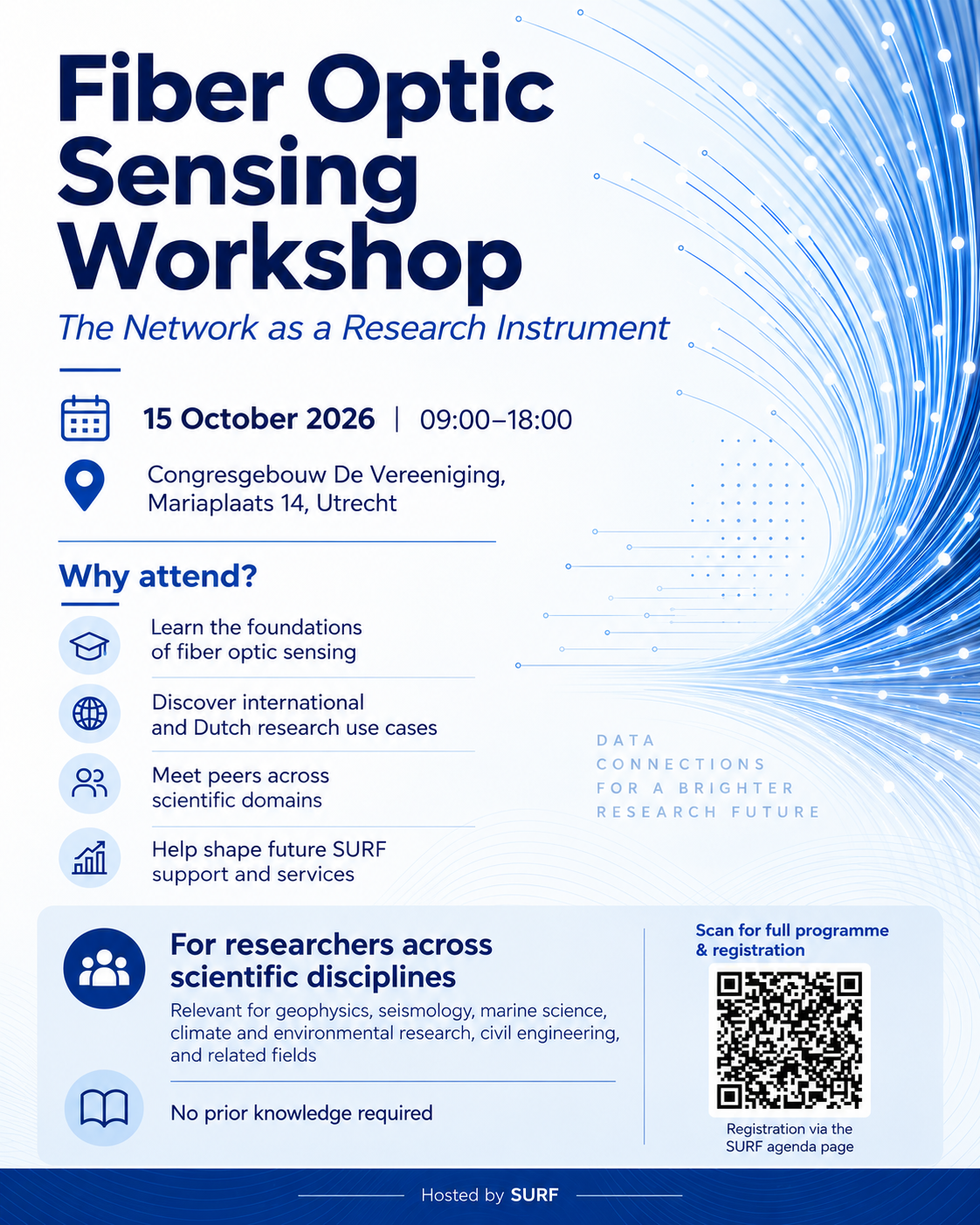
    On Thursday 15 October, SURF is bringing together researchers from different scientific disciplines for a one-day Fiber Optic Sensing Workshop in Utrecht.

    We are particularly keen to connect with researchers whose work could benefit from using existing fiber infrastructure as a distributed sensing instrument — for example in geophysics, seismology, marine science, environmental and climate research, civil engineering, and related fields.

    The focus of the workshop is very much on the science and the research use cases. What can technologies such as Distributed Acoustic Sensing (DAS) make possible? What kinds of measurements, coverage and data could be valuable to different disciplines? And what would researchers need from fiber sensing infrastructure if we want to move from individual experiments towards more structural and scalable research capabilities?

    The day will combine an introduction to the technology with international and Dutch research examples, ongoing projects, discussion across scientific domains, and short pitches from researchers who would like to explore or share a potential fiber sensing use case.

    We will also have a live demonstration with a DAS unit and look at the wider research landscape around fiber sensing, including funding opportunities, consortia and collaboration, and how SURF’s data and compute infrastructure could support this type of research.

    Previous experience with fiber sensing is not required. We are just as interested in researchers who are curious whether this could provide a useful new source of data for their work.

    If this sounds relevant to your research — or to someone in your research network — please have a look and feel free to share.

    Fiber Optic Sensing Workshop: The Network as a Research Instrument
    Date: 15 October 2026
    Place: Utrecht, the Netherlands
    Language: English


    To sign up, please use the registration tool under this link:

  • SURF network continues to innovate: intelligent, independent and flexible

    SURF network continues to innovate: intelligent, independent and flexible

    SURF network continues to innovate: intelligent, independent and flexible

    SURF is building a new generation of the SURF network. We are doing this with a new network architecture and the further development of the network automation stack into an intelligent network. The network is based on open standards and procurement of network equipment goes through an intermediary.

    With this further development of SURF’s network, we can respond more flexibly and faster to technological innovations and reduce dependence on suppliers. With the new network architecture and a smart, flexible replacement strategy, we are also working towards a more sustainable network.

    Digital highway in the Netherlands

    With the SURF network, Dutch education and research have their own autonomous network infrastructure. In line with our public values, we determine accessibility, freedom of choice and privacy on our network ourselves. Since 1988, based on these principles, we have been building this own digital highway, intended for independent and reliable research and knowledge sharing.

    The SURF network has several features that allow students, teachers and researchers to collaborate safely, reliably and at lightning speed worldwide.This is due to the high continuity and reliability of the SURF network, which simply must always be available.The SURF network also has high bandwidth for moving large amounts of data. Low latency ensures minimal travel time between sending and receiving data within the network. Moreover, all network services are integrated with each other, and we are working to ensure proper integration with other SURF services.

    Growth in network traffic

    Ever since SURF was founded, Internet traffic has been growing by around 29% annually. For research projects, this percentage is sometimes even higher. This growth is one of the reasons why network technology continues to evolve so rapidly and why SURF’s network has to be renewed every 5 to 8 years. Equipment is ageing rapidly and the demand for capacity continues to grow rapidly.

    New approach for the SURF network

    In 2024, we started the project to set up a new generation of the network after SURFnet8.In previous generations of the SURF network, from SURFnet1 to SURFnet8, the architecture was strongly determined by the choice of a network equipment supplier. With the latest generation of the network, SURF aims to be a supplier of independent architecture. Based on open standards, new technologies can be applied where they are needed and the network can continue to develop indefinitely. Hence this new generation is not called SURFnet9, but SURFnet Infinity.

    Workflow Orchestrator

    The first step for this new network architecture was already taken in 2018. With the Workflow Orchestrator developed by SURF based on open source software, various technology domains within the network can be centrally controlled. The Orchestrator ensures that tasks are performed in the right order and data is passed on correctly so that bottlenecks are prevented and reliability increases. This lays a solid foundation for the next step: further development towards an intelligent network in SURFnet Infinity.

    Purchase of network equipment via intermediary

    The purchase of network equipment is organised via an intermediary. In this way, SURF has greater freedom to make technology choices and can respond more flexibly and efficiently to the network needs of educational and research institutions when purchasing network equipment, without being tied to a single supplier.

    New SURFnet Infinity network architecture

    SURF’s new network architecture has established a clear hierarchy and separation of functions between the transport of network traffic, the provision of services to end users and connectivity to the Internet. This will facilitate capacity management, make the network more predictable, make it easier to detect and solve problems and provide more targeted security.It also moves a significant part of the network core from a commercial data centre to Nikhef’s data centre. The four core locations of SURF’s network are thus located within its own cooperative.

    First equipment purchased

    After an extensive selection process, SURF recently purchased the equipment to build the new core and border functionality. This directly realises the new architecture of the SURFnetwork.

    For the SURFnet Infinity network infrastructure, SURF has chosen the Juniper PTX series, which is even more powerful, compact and energy-efficient than the outdated MX series used by SURF. In addition, SURF is working with Salumanus as an independent supplier of transceivers based on OpenZR+ technology. This combination allows routers to connect directly to DWDM infrastructure, without the use of separate optical equipment. This not only reduces costs and energy consumption, but also increases network flexibility and future-proofing. Moreover, by choosing an independent supplier, the lifetime of the transceivers is not linked to that of the router hardware.

    Start of further development of SURFnet Infinity

    The further development of the SURF network starts with the renewal of the heart of our network: the core and border routers.Together with our management partner Quanza, we started preparations in the summer of 2025 .

    At 55 locations throughout the Netherlands, we will replace SURFnet8 equipment with new equipment.Most of the institutions connected to the SURF network will not be affected. For the work, we will contact our contact persons directly.This migration will run until early 2027.

    For international connections, in this phase we also replace the NetherLight equipment and optimise our Cross Border Fiber infrastructure. In the years after 2027, we plan to replace the optical equipment that facilitates high capacity between network components, as well as the access layer to which all institutions are connected.

    Want to know more about SURFnet Infinity?

    Follow this project on this page.
    We also post regular project updates on the network dashboard.
    Are you a network specialist?Then subscribe to the updates on the SURFnetwork Infinity project.

  • SURF partners with HPE and Salumanus for multi-vendor and high-performance network design

    SURF has selected HPE to deliver solutions for the backbone and border network domains, and Salumanus is selected to deliver the coherent transceivers. Together with partner Nomios we will implement the next generation SURF network infrastructure, designed to meet the rapidly growing demand for bandwidth, predictability, and resilience across the Netherlands’ research and education community.

    To be able to meet future challenges, SURF needs to innovate their network continuously. For that purpose, it has designed a new network architecture and will start replacing the network in various phases over the next few years. Within the new architecture, the SURF network delivers 800GE, 400GE and 100GE connectivity. Using OpenZR+ technology from Salumanus, SURF increases its backhauling capability, both in terms of bandwidth and distance.

    “This new architecture gives SURF exactly what our members need: higher capacity, predictable performance, stronger security and the freedom to scale without being tied to a single vendor. It allows us to upgrade faster, operate the network more efficiently and ensure that every institution benefits from a platform that is ready for the demands of the next decade.” Said Harold Teunissen, Head of Network & Infrastructure Services, SURF

    HPE Networking for backbone & border

    HPE delivers the backbone and border domains of the new SURF network with PTX Series Routers (PTX10008 and PTX10002-36QDD, with Express 5 silicon’s unparalleled power efficiency), connecting SURF’s IP peering and the NetherLight global exchange point. The solution includes HPE vRR (Networks virtual Route Reflector) for simplified routing management and scalability, as well as Corero comprehensive anti-DDoS capability to safeguard research and education traffic against large-scale cyberattacks—ensuring resilient, efficient and secure connectivity for critical scientific and academic applications.

    “HPE is proud to support SURF in building a resilient, high-performance network for the Netherlands’ research and education community. By delivering advanced routing, security, and data privacy solutions, we help empower local institutions to collaborate, innovate, and protect sensitive information”, commented Dobias van Ingen, EMEA CTO HPE Networking

    Salumanus technology  

    At the heart of this transformation is the migration of SURF’s existing CWDM-based access network to DWDM (Dense Wavelength Division Multiplexing) technology. This step is crucial to enable a smooth and scalable upgrade of existing links to 100G and higher capacities, ensuring that member institutions can benefit from next-generation optical performance.

    In parallel, the backbone network will be upgraded to 400G and 800G using IP over DWDM technology. This approach allows SURF to deliver ultra-high-speed connectivity, eliminating the need for separate transponder hardware, minimizing power consumption and space utilisation while significantly reducing capital and operational costs.

    “We are proud to support SURF in its mission to deliver world-class connectivity, our OpenZR+ technology and DWDM solutions will help build a network that is smarter, more efficient, and ready to meet the demands of the future.” Said Marcin Bala, CTO of Salumanus

    Continued collaboration with Nomios

    Nomios plays a key role as systems integrator in coordinating hardware purchasing and lifecycle management across suppliers and domains for the next generation of SURF network infrastructure. SURF has engaged Nomios to assist in selecting technology partners and executing the mini competition process on behalf of SURF. This collaborative model allows SURF to continuously innovate while maintaining maximum flexibility and vendor diversity.

    “We’re supporting SURF in selecting the right technology mix and keeping the multi-vendor model practical across all network domains. This next step in their architecture gives the research and education community in the Netherlands the bandwidth and predictability they need for the years ahead.” Said Mohamed El Haddouchi, Managing Director Nomios

    About SURF

    SURF is the IT cooperative of Dutch education and research institutions. The members, the owners of SURF, join forces to develop or procure the best possible digital services, work together on complex innovation issues and develop and share knowledge with each other.

    SURF designs, builds, and manages the national research and education network, the SURF network, that connects universities, research institutes, and other knowledge organisations.

    About Salumanus

    Salumanus provides advanced optical networking solutions across Europe, specialising in DWDM and transceiver technology. The company supports network operators, enterprises, and research networks in building flexible and cost-effective infrastructures.

    About Nomios

    Nomios is a European leader in secure networking and cybersecurity services and solutions. The company designs, implements, and manages resilient digital infrastructures, with a strong focus on innovation and long-term collaboration.

  • Education Championship patching

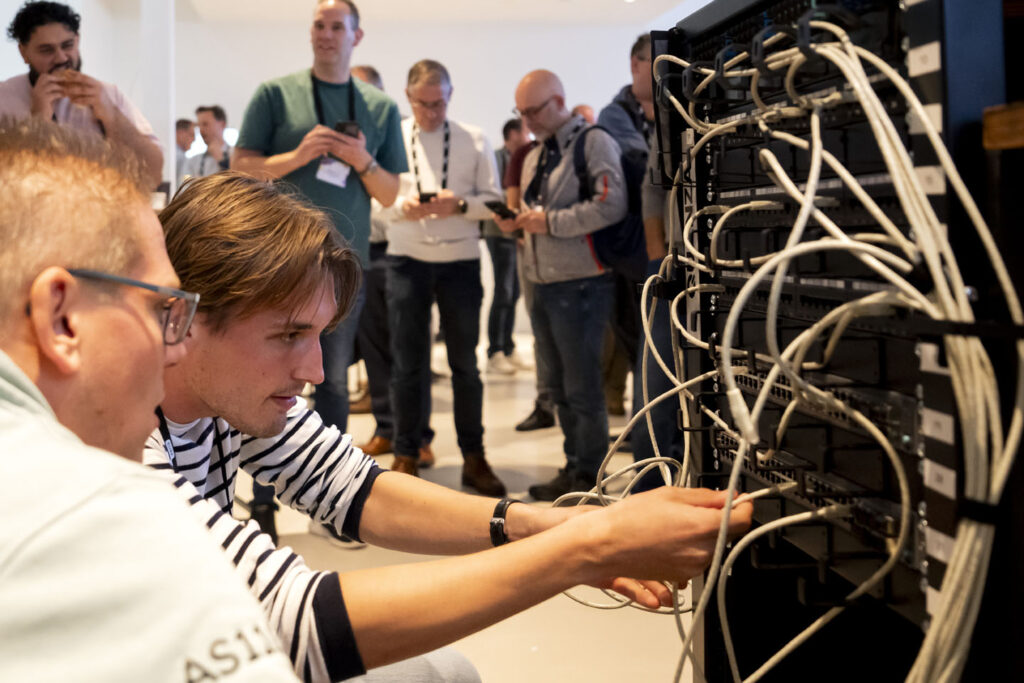
    The first Education Championship patching at the SURF Network and cloud event 2025 was a great success!

    Over Ten participants competed for the title of patchmaster. There was serious competition and a finishing time that got tighter and tighter with Dimitry Schoenmakers from Tilburg University as the eventual winner!

    Dimitry many congratulations on the challenge cup!

    Are you also a SURF member and would you like to show off your patching skills and run away with the challenge cup next time? Then join the sign community! https://communities.surf.nl/sign/about

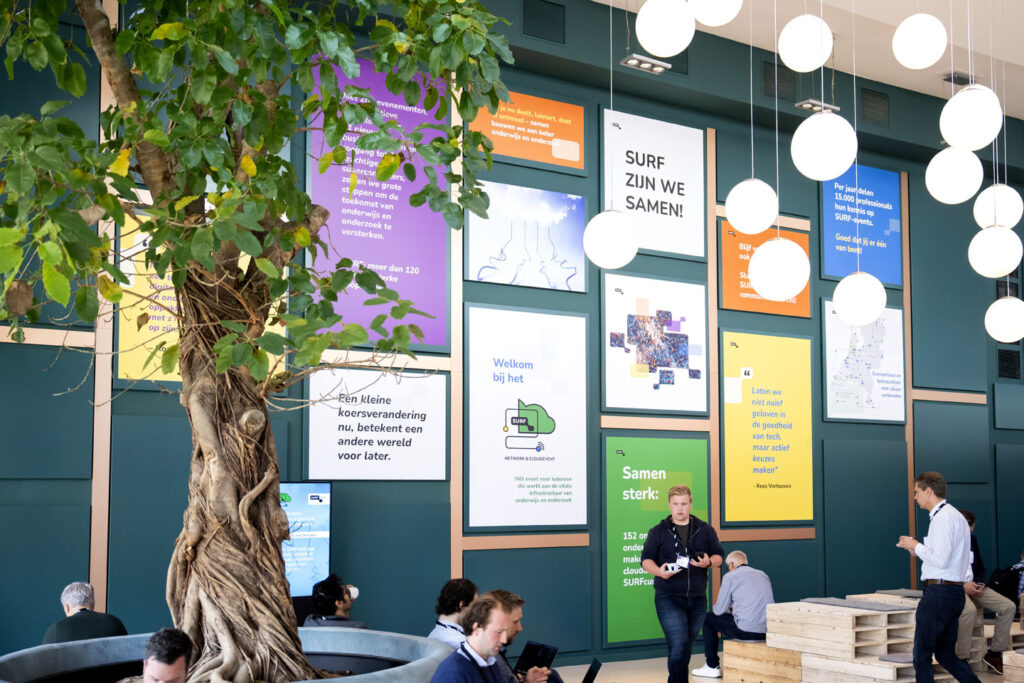
    De Beeldredaktie / Sander Koning t.b.v SURF Hilversum d.d. 30.09.2025 SURF Netwerk & Cloud Event 2025 in Gooiland Hilversum Foto copyright – Sander Koning
    De Beeldredaktie / Sander Koning t.b.v SURF Hilversum d.d. 30.09.2025 SURF Netwerk & Cloud Event 2025 in Gooiland Hilversum Foto copyright – Sander Koning

    De Beeldredaktie / Sander Koning t.b.v SURF Hilversum d.d. 30.09.2025 SURF Netwerk & Cloud Event 2025 in Gooiland Hilversum Foto copyright – Sander Koning
    De Beeldredaktie / Sander Koning t.b.v SURF Hilversum d.d. 30.09.2025 SURF Netwerk & Cloud Event 2025 in Gooiland Hilversum Foto copyright – Sander Koning
  • International Collaboration at SuperComputing24: NetherLight/SURF participates in NICT-led experiment to advance high-speed data innovations

    International Collaboration at SuperComputing24: NetherLight/SURF participates in NICT-led experiment to advance high-speed data innovations

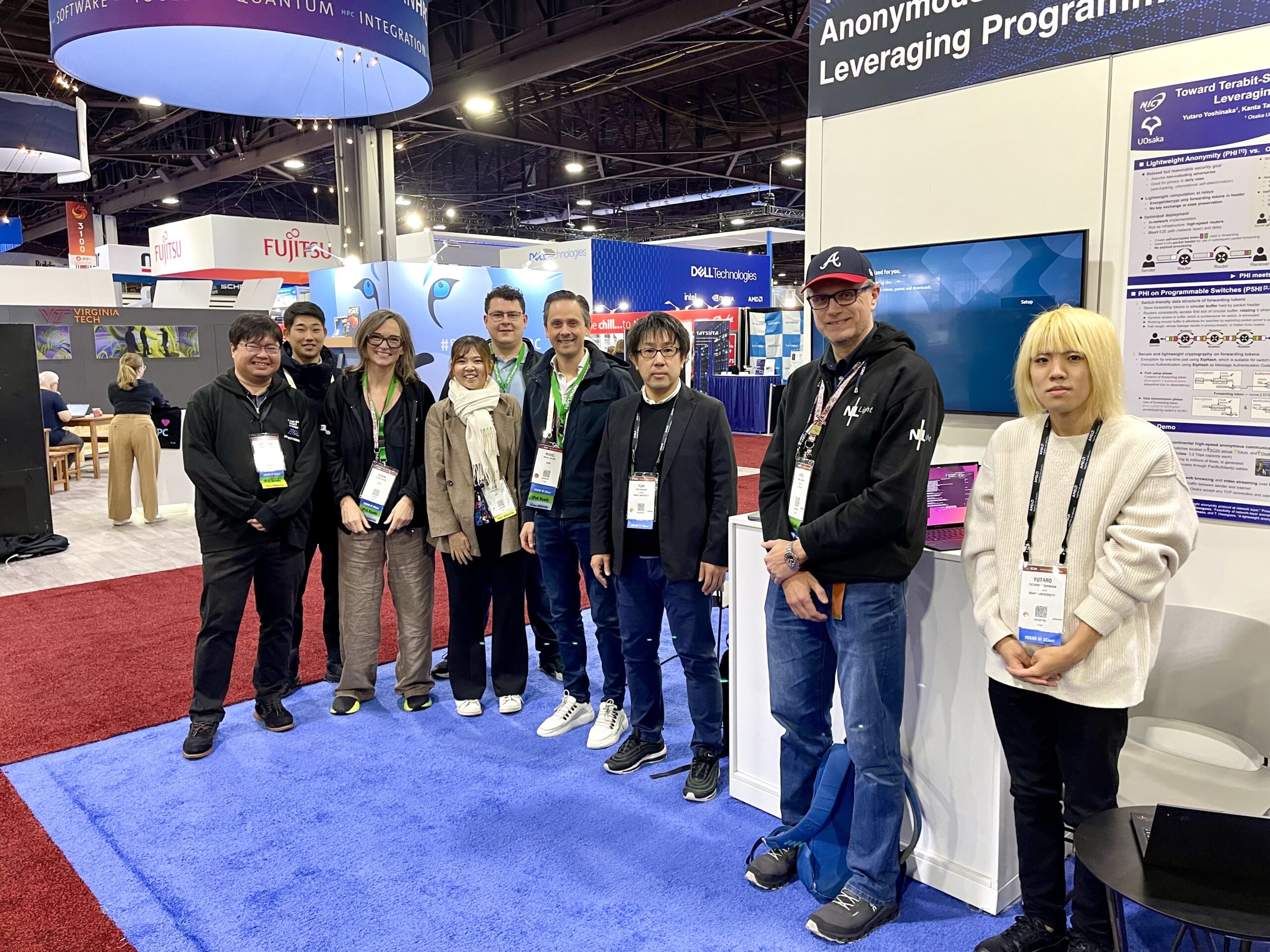
    During the SuperComputing 2024 (SC24) event in Atlanta, the Japanese National Institute of Information and Communications Technology (NICT) led an ambitious experiment using a global-scale experimental network. This network, established through collaboration with 19 international partners, connected Tokyo and Atlanta with 10 high-speed 100 Gbps paths, achieving a total capacity of 800 Gbps. The project showcased groundbreaking demonstrations of high-speed data transfer, anonymous communication, and innovative data management.

    One notable highlight was a data transfer experiment that reached 466 Gbps, and an award-winning anonymous communication demonstration by Osaka University achieved 588 Gbps while ensuring robust privacy. 

    NetherLight, the Global Exchange Point (GXP) run by SURF, played a critical role facilitating these complex experiments. Other key contributors included research and education networks and GXP’s from around the world, showcasing the collective effort required to achieve such innovation.

    This NICT experiment at SC24 emphasizes the importance of international collaboration and partnerships in global research and education networks. By working together in experiments like these, we can collectively show and assess the potential for transformative technologies in data handling and communication, essential for future scientific progress.

    For more details, pictures and graphics, and information about the contributing parties in this experiment, please read the full NICT press release here.