Tag: innovation

  • Researchers! Could the fiber network itself become a new research instrument for your field?

    Researchers! Could the fiber network itself become a new research instrument for your field?


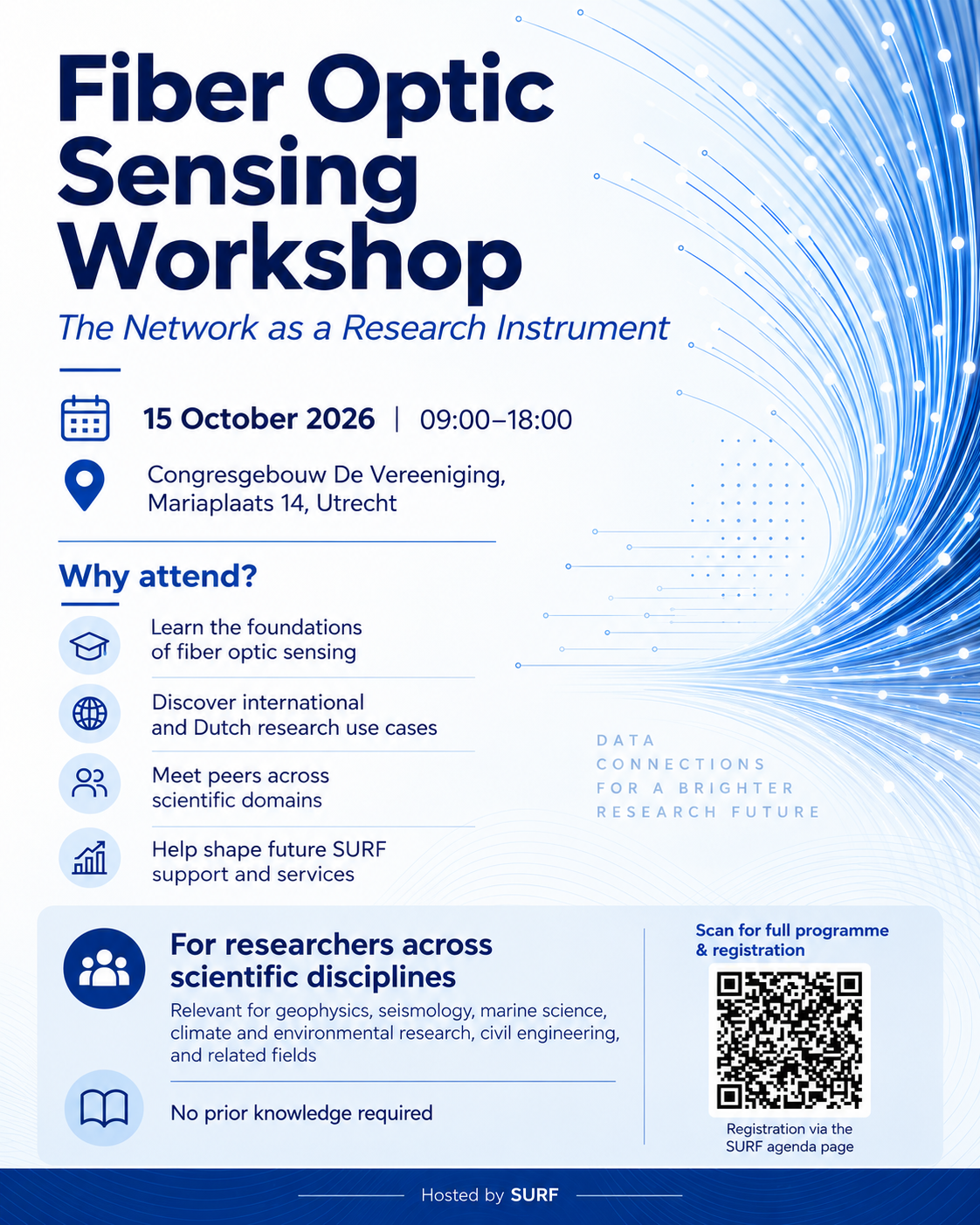
    On Thursday 15 October, SURF is bringing together researchers from different scientific disciplines for a one-day Fiber Optic Sensing Workshop in Utrecht.

    We are particularly keen to connect with researchers whose work could benefit from using existing fiber infrastructure as a distributed sensing instrument — for example in geophysics, seismology, marine science, environmental and climate research, civil engineering, and related fields.

    The focus of the workshop is very much on the science and the research use cases. What can technologies such as Distributed Acoustic Sensing (DAS) make possible? What kinds of measurements, coverage and data could be valuable to different disciplines? And what would researchers need from fiber sensing infrastructure if we want to move from individual experiments towards more structural and scalable research capabilities?

    The day will combine an introduction to the technology with international and Dutch research examples, ongoing projects, discussion across scientific domains, and short pitches from researchers who would like to explore or share a potential fiber sensing use case.

    We will also have a live demonstration with a DAS unit and look at the wider research landscape around fiber sensing, including funding opportunities, consortia and collaboration, and how SURF’s data and compute infrastructure could support this type of research.

    Previous experience with fiber sensing is not required. We are just as interested in researchers who are curious whether this could provide a useful new source of data for their work.

    If this sounds relevant to your research — or to someone in your research network — please have a look and feel free to share.

    Fiber Optic Sensing Workshop: The Network as a Research Instrument
    Date: 15 October 2026
    Place: Utrecht, the Netherlands
    Language: English


    To sign up, please use the registration tool under this link:
  • SURF and Nikhef complete test with Ciena’s WaveLogic technology showing multiple 1 Terabit paths for scientific research between Amsterdam and Geneva

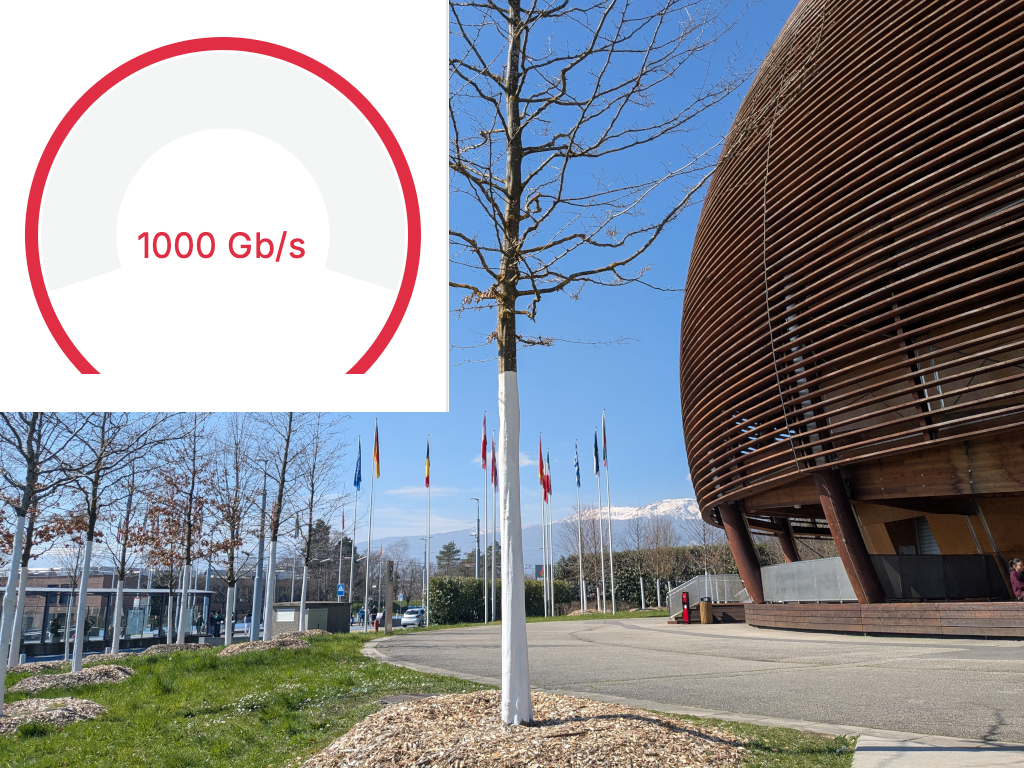
    SURF and Nikhef complete test with Ciena’s WaveLogic technology showing multiple 1 Terabit paths for scientific research between Amsterdam and Geneva

    SURF, Nikhef and Ciena have successfully tested multiple 1 Tbps paths over fiber between SURF and Nikhef in Amsterdam and CERN in Geneva. The test, powered by Ciena’s WaveLogic 6 Extreme, shows that technological innovations can significantly improve the bandwidth of existing infrastructure.

    A similar development was seen earlier in connections over copper. Where initially only 2,4 kilobits per second was achievable over a classical phone connection, enhanced coding techniques brought this to 50 megabits (VDSL) per second over the same infrastructure. We are seeing the same trend in fiber technology.

    For SURF, this increase in capacity is of great importance. The scientists that SURF supports are able to measure ever more accurately, which leads to explosive growth in the amount of measurement data that SURF has to transport. An example of this is the Large Hadron Collider at CERN, which will be upgraded to much higher precision in the coming years (https://home.cern/science/accelerators/high-luminosity-lhc). 

    SURF and Nikhef together operate a  Tier-1 site for storage and processing of this LHC measurement data. For this purpose, a special 1648 km long fiber path has been established between Geneva and Amsterdam. This trajectory will need to transport much more data in the near future. However, this path also presents a technical challenge due to its long distance, age, fiber type, and the number of small spans that make up this trajectory.

    Vendors of optical equipment continuously come up with improvements for fiber connections like their colleagues did for copper lines in the past. To see what is possible with the most modern optical equipment, SURF and Nikhef therefore regularly conduct trials with these suppliers. In March 2025, we conducted a trial with Ciena over our existing Amsterdam-Geneva connection. In this trial we were able to achieve speeds exceeding 1 Terabit per second over this challenging fiber path. We thank Ciena for the opportunity to do these tests and for its support. These results give us sufficient insights to be sure that at the technical level we can transport the upcoming LHC-data explosion to SURF and Nikhef in Amsterdam.

  • International Collaboration at SuperComputing24: NetherLight/SURF participates in NICT-led experiment to advance high-speed data innovations

    International Collaboration at SuperComputing24: NetherLight/SURF participates in NICT-led experiment to advance high-speed data innovations

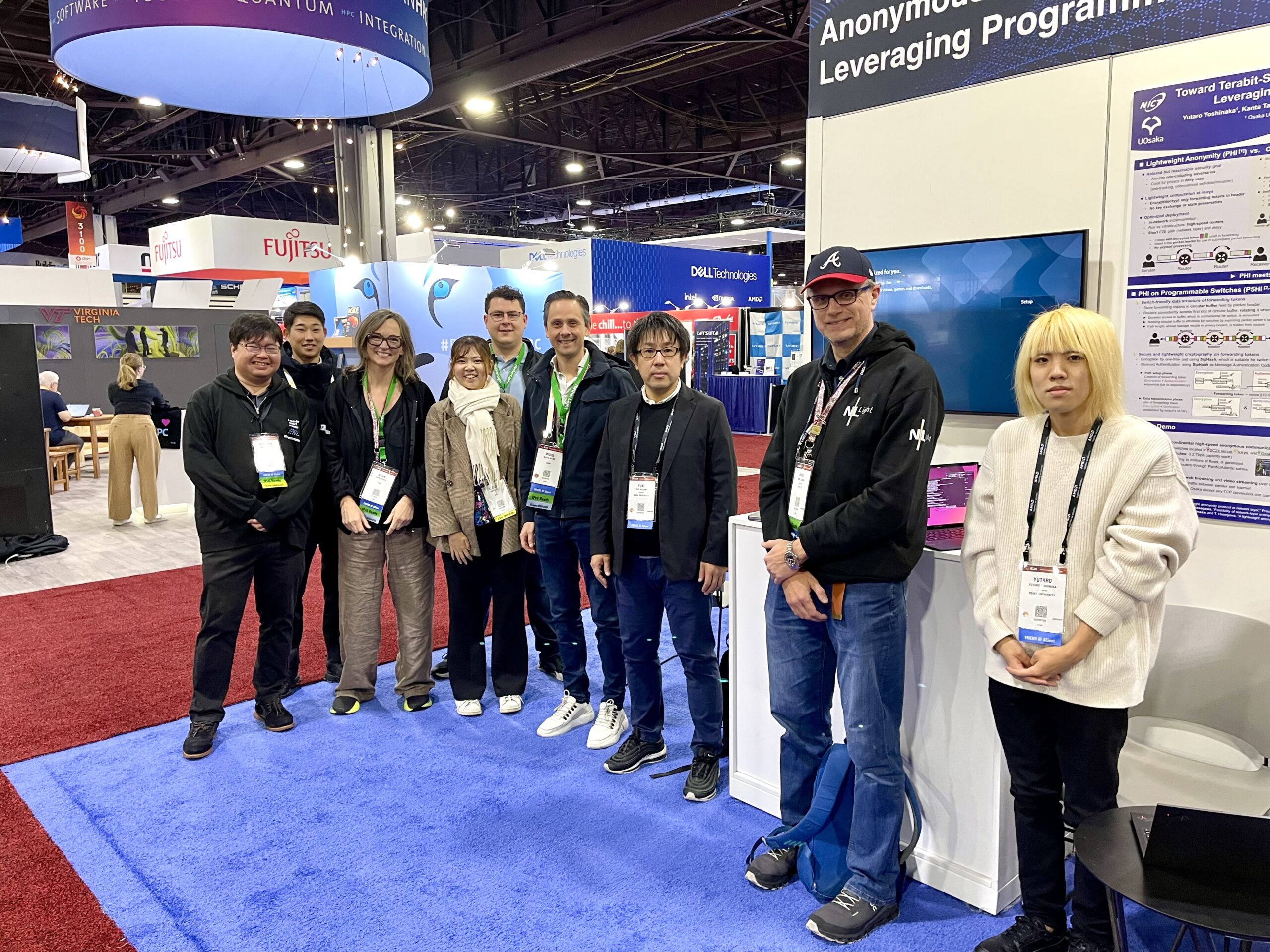
    During the SuperComputing 2024 (SC24) event in Atlanta, the Japanese National Institute of Information and Communications Technology (NICT) led an ambitious experiment using a global-scale experimental network. This network, established through collaboration with 19 international partners, connected Tokyo and Atlanta with 10 high-speed 100 Gbps paths, achieving a total capacity of 800 Gbps. The project showcased groundbreaking demonstrations of high-speed data transfer, anonymous communication, and innovative data management.

    One notable highlight was a data transfer experiment that reached 466 Gbps, and an award-winning anonymous communication demonstration by Osaka University achieved 588 Gbps while ensuring robust privacy. 

    NetherLight, the Global Exchange Point (GXP) run by SURF, played a critical role facilitating these complex experiments. Other key contributors included research and education networks and GXP’s from around the world, showcasing the collective effort required to achieve such innovation.

    This NICT experiment at SC24 emphasizes the importance of international collaboration and partnerships in global research and education networks. By working together in experiments like these, we can collectively show and assess the potential for transformative technologies in data handling and communication, essential for future scientific progress.

    For more details, pictures and graphics, and information about the contributing parties in this experiment, please read the full NICT press release here.